
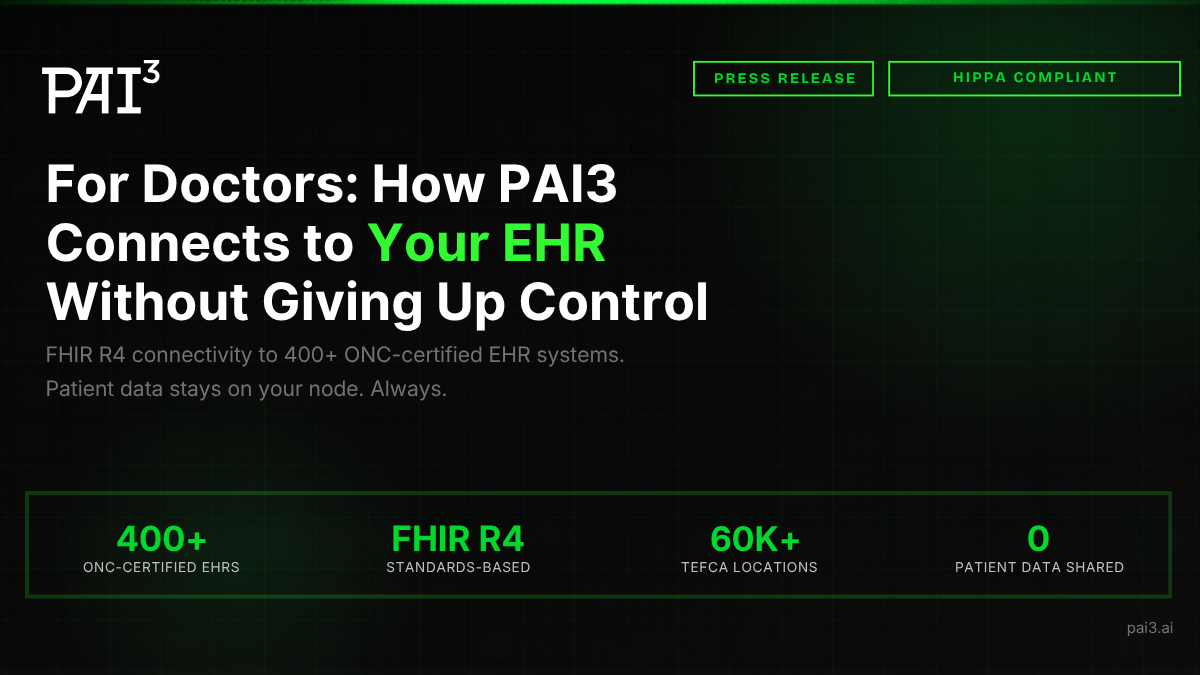
 Cheyenne, WY — April 29, 2026 - PAI3 Network today unveiled its healthcare integration roadmap, centered on a FHIR R4 client core that will enable connectivity to any of the 400+ ONC-certified electronic health record systems in the United States. The first integration target is Office Practicum, a leading pediatric EHR, driven by an active client engagement.
The healthcare roadmap represents PAI3’s first vertical-specific initiative and addresses a fundamental tension in health IT: the 21st Century Cures Act mandates data interoperability, but existing solutions route patient data through centralized intermediaries, creating concentration risk and regulatory complexity.
PAI3’s architecture resolves this tension by running FHIR queries directly from the healthcare provider’s own node. Patient data flows from the EHR to the provider’s encrypted cabinet - never through PAI3 infrastructure, never stored on third-party servers, and always under the provider’s sole custody.
“Every healthcare AI company asks doctors to trust them with patient data. We’re building something fundamentally different: AI infrastructure where the doctor is the custodian. The FHIR client core connects to the EHR. The data stays on the doctor’s node. The AI agents run locally. We provide the platform. They keep the data.” - Pradeep Goel, CEO, PAI3 Network
FHIR Client Core Capabilities
The FHIR Client Core will support parameterized patient queries, immunization history, active medications, encounter records, vital signs, lab results, and clinical documents (C-CDA). It will support SMART on FHIR authentication for secure, standards-based access and Bulk FHIR for population-level analytics.
High-Value Clinical Workflows
The platform enables clinical workflows that address real operational pain points for healthcare providers:
Immunization Gap Detection - Automated comparison of patient immunization records against CDC schedules, flagging overdue or missing vaccinations with provider-facing alerts.
Well-Child Visit Tracking - Monitoring against AAP Bright Futures guidelines to identify patients overdue for developmental screenings and preventive care visits.
Growth Chart Monitoring - Trend analysis of growth trajectories with alerting when a child’s measurements cross percentile lines in clinically significant patterns.
Lab Result Critical-Value Notification - Real-time flagging of abnormal lab results that require immediate clinical follow-up, with automated routing to the responsible provider.
These workflows run entirely on the provider’s Power Node. Patient data is processed locally, stored in AES-256-GCM encrypted cabinets, and never transmitted to PAI3 or any third party.
Health Information Exchange Architecture
The roadmap extends beyond individual EHR connections. PAI3 has designed a three-layer architecture for Health Information Exchange (HIE) access:
Layer 1: Shared FHIR Client Core - A reusable module that speaks the standard healthcare data language, supporting connections to any FHIR R4-compliant system.
Layer 2: Per-Network Connection Adapters - Adapters for TEFCA Qualified Health Information Networks (QHINs) including eHealth Exchange, CommonWell, and Carequality - spanning 60,000+ connected locations nationwide.
Layer 3: Cross-State Query Orchestrator - Aggregates patient records across providers, states, and networks — all from the doctor’s own node, all with data remaining under the provider’s custody.
Compliance by Architecture
Healthcare-specific features will begin shipping in V3.4.1 behind a feature flag. HIPAA compliance capabilities include HIPAA-specific cabinet types with enforced access controls, 6-year audit retention meeting federal record-keeping requirements, and SQLCipher-encrypted databases for data at rest.
The platform’s architecture is designed to support HIPAA requirements by default: patient data never leaves the provider’s hardware, all operations are audit-logged, and encryption keys are managed through PAI3’s self-sovereign key architecture where no single party - including PAI3 - can access patient data.
Real-World Deployment
Pediatric Value-Based Care: Pediatrics Clinic is building physician-facing AI for value-based care risk management on PAI3. Patient data stays on his Power Node. The FHIR integration will connect directly to his Office Practicum EHR, enabling automated quality measure tracking and care gap identification - all on-premise.
Functional Medicine: A functional medicine practice is building advanced diagnostic AI on PAI3, processing complex patient intake data and lab panels locally. No patient data leaves the practice. The FHIR client core will enable structured lab result ingestion from connected EHR systems.
Sports Medicine: A sports medicine practice is developing AI for concussion and injury recovery protocols on PAI3 infrastructure, with clinical data processed on sovereign hardware.
Market Traction
PAI3 reports more than 500 Power Nodes deployed from a fixed, architecturally-capped supply of 3,141 units. The platform is in active production use across healthcare, legal, and enterprise environments. PAI3 was named a Top 10 AI Project of 2025 by the Binance Incubation Alliance, was a Top 5 Finalist at Consensus 2025 Global, and maintains 50+ ecosystem partners including membership in the Government Blockchain Association.
Availability
The FHIR Client Core and healthcare-specific features are targeted for PAIneer V3.4.1, with early adopter access available for Power Node operators in healthcare. Learn more at pai3.ai.
About PAI3 Network
PAI3 Network is a decentralized personal AI infrastructure platform that enables professionals and enterprises to deploy AI agents, manage encrypted data cabinets, and connect to external systems - all on hardware they own. The platform is designed for regulated industries including healthcare, legal, finance, and government. Over 500 Power Nodes are deployed across a fixed network of 3,141 units.
Learn more at https://pai3.ai/