
 Photo from Unsplash
Originally Posted On: https://www.buzzcube.io/chat-gpt-zero-explained/
Chat GPT Zero Explained: Can It Really Detect AI Writing?
AI-generated articles now outnumber human-written content published online, a milestone that has sparked two opposing reactions. For some, this signals an apocalyptic future where AI commodifies writing and drowns out authentic voices. For others, it represents a dream technology that democratizes content.
The reality, as with most technological shifts, sits somewhere in the middle.
This abundance of AI writing has created a practical problem: distinguishing genuine human insight from machine-generated text has become genuinely difficult. Educators face plagiarism concerns. Content teams worry about brand voice dilution. Publishers question authenticity. Tools like GPT Zero enter the conversation precisely because this need is urgent.
GPT Zero has emerged as one of the most discussed AI detection tools, designed to identify whether text was written by humans or generated by ChatGPT and similar models. We are discussing, how accurate is GPT Zero really? Can it reliably detect AI writing, or does it produce false positives that undermine trust? And when you compare GPT Zero to other AI detection tools, where does it actually stand?
What Is GPTZero and Why It Matters
GPTZero tries to figure out if a human wrote something or if ChatGPT (or similar AI) generated it. You paste in text, it analyzes the patterns, and tells you the AI probability score. It also highlights specific parts of the text that look AI-generated.
The tool looks for linguistic patterns that differ between how humans write and how machines write.
Why does this matter?
For different reasons. Teachers use it to spot AI-generated homework. Content teams want to make sure their published stuff actually came from human writers. Publishers need to verify that articles with someone’s name on them weren’t just churned out by a bot. The basic goal across the board: to tell human writing apart from AI.
How GPTZero Works
GPTZero measures two things to spot AI writing: perplexity and burstiness.
Perplexity = How predictable your words are. If the detector can easily guess what word comes next, that’s high perplexity – a sign of AI.
Burstiness = How much your sentence length varies. Humans mix it up. One sentence might be short. The next one could be significantly longer and more detailed. AI tends to keep sentences roughly the same length and rhythm throughout.
Think about how you actually write versus how ChatGPT writes. You probably shift between casual and formal, between choppy and flowing. AI stays pretty consistent – smooth, even, predictable. GPTZero picks up on that difference and uses it to estimate whether a human or a machine wrote the text.
What It Can Detect
GPTZero is specifically designed to flag content from ChatGPT, GPT-4, Claude, and similar models. It works best on longer passages (200+ words) because there is more material to analyze. Short paragraphs are harder to evaluate, and extremely edited or rewritten content can confuse not only GPTZero but any detection system.
The tool is most confident when reviewing pure AI output. Hybrid writing, where a human edits machine-generated text or where AI adjusts human writing, remains more difficult to classify. This is common with all AI detectors because blended styles reduce the distinct patterns that normally separate the two.
Which AI Models Does GPTZero Detect?
GPTZero specifically detects content from the latest AI models as of early 2026:
OpenAI:
- GPT-5.2 (with Thinking mode)
- GPT-5 and GPT-5 Pro
- GPT-4o, GPT-4 Turbo, GPT-4
- o3 and o3-mini reasoning models
- Older GPT-3.5 variants
Anthropic:
- Claude Opus 4.5 and Claude Opus 4.1
- Claude Sonnet 4.5 and Claude Sonnet 4
- Earlier Claude 3 family models
Google:
- Gemini 3 Pro (including Deep Think mode)
- Gemini 2.5 Pro and Gemini 2.0 Flash
- Earlier Gemini 1.5 variants
Meta:
- Llama 4 (Maverick and Scout versions)
- Llama 3.3, 3.2, and earlier releases
Other Major Models:
- Grok 4.1 and Grok 3 (xAI)
- DeepSeek V4, R1, and V3
- Mistral AI models
- Qwen 3 and Qwen 2.5 (Alibaba)
- Cohere Command models
GPTZero focuses on detecting generative AI that writes complete sentences and full paragraphs. It doesn’t flag older writing assistants like Grammarly, grammar checkers, or basic autocomplete tools. The detection algorithms get updated regularly to keep pace with new model releases throughout 2026 and beyond.
How Accurate Are AI Detectors & Real Limitations
GPTZero claims 85-90% accuracy, but this fluctuates. Academic and technical documents reveal stronger signals, while creative or conversational writing can overlap with AI patterns. This leads to occasional false positives, which occur when a human writer uses a very consistent tone or repeats necessary phrasing.
GPTZero Accuracy Rate
- Claims: 85-90% accuracy on pure AI text
- Real-world: Varies by content type
- Best performance: Academic papers, technical writing
- Weakest performance: Creative writing, poetry, heavily edited content
- False positive rate: 5-15%, depending on writing style
Where AI Detectors Struggle
Students with a recognizable style or authors who prefer tight, uniform structure may be flagged even when their work is completely original.
It also struggles with heavily revised AI text. When a person rewrites or restructures generated content, the AI signature fades and becomes harder to detect. This is not a unique flaw of GPTZero but a limitation of AI detection in general.
Why Some Famous Texts Trigger High AI Scores
False positives in AI detectors can appear even when scanning well-known human-written material. For example, here is the excerpt from the first chapter of J. K. Rowling’s Harry Potter, that receives an AI score 98%.
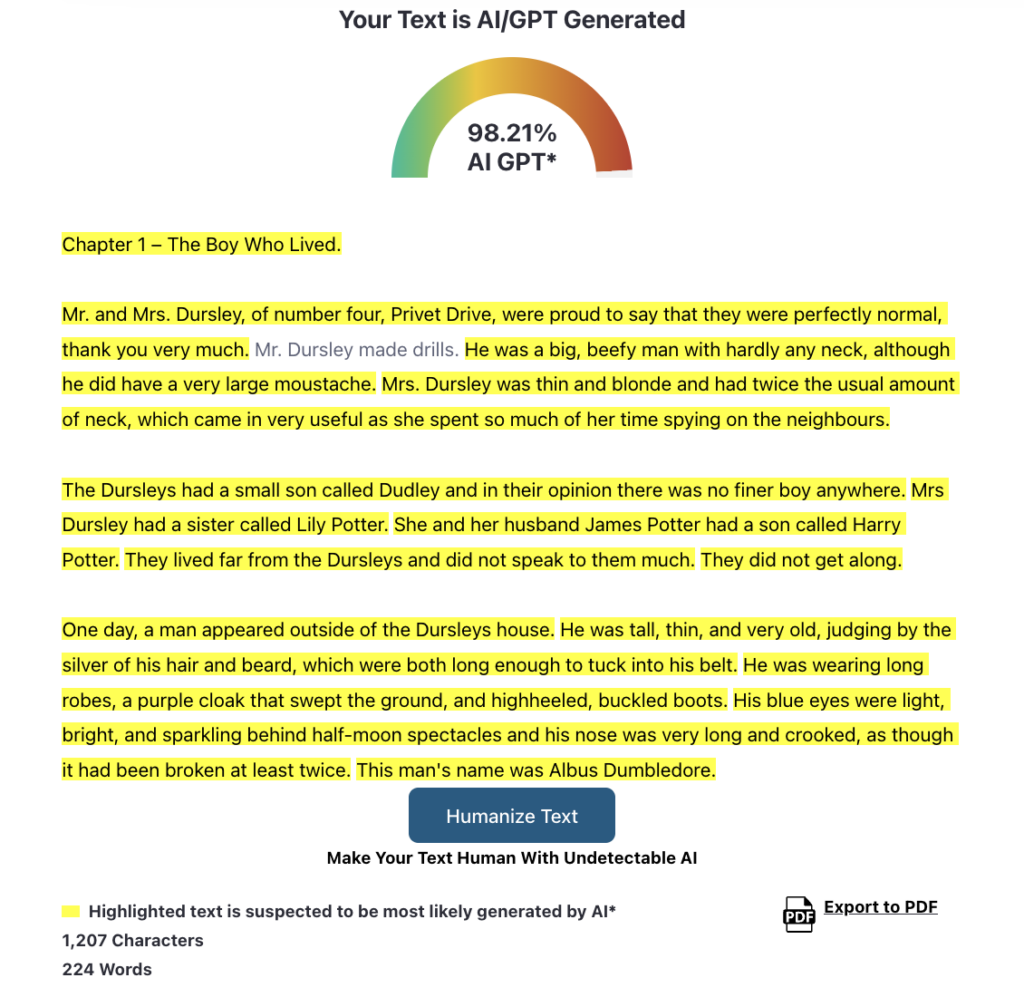
This does not indicate that the writing resembles modern AI output. It highlights how detection systems respond to patterns rather than context. These texts often use consistent structure, recognizable phrasing, and stylistic repetition. So detectors recognize the patterns and lean toward an AI classification. This creates a bias that can push the score higher than expected, even when the work is entirely human-written.
Why It Works Best as a Screening Tool
These gaps highlight why AI detectors work best as a screening tool. It reveals patterns that deserve attention, but it cannot determine intent or confirm authorship on its own. The tool helps users understand how a piece of writing was produced, but it should be paired with context and thoughtful review. Detection identifies source, not quality.
Can You Bypass GPTZero?
Yes, GPTZero can be bypassed, and people do it, this is how it usually happens:
Common bypass methods:
- Heavy manual editing and rewriting of AI output
- Mixing AI-generated sentences with your own writing
- Using AI humanizer tools that scramble the patterns
- Adding personal stories, examples, and specific details
- Changing sentence structures and rhythm deliberately
- Running AI text through paraphrasing tools multiple times
But honestly, if you’re editing AI text heavily enough to bypass GPTZero, you’re basically rewriting it anyway. At that point, you’ve done enough work that the content probably reflects your own thinking.
The goal shouldn’t be “how do I trick the detector.” It should be “how do I create content that’s actually useful.” GPTZero and similar tools exist because pure AI output often lacks the depth, nuance, and real-world context that makes writing valuable.
If you’re putting in effort to bypass detection, redirect that effort into making the content genuinely better instead.
What If GPTZero Flags Your Human Writing?
This happens more often than it should, especially if you write in certain styles, but don’t worry, here’s what you can do:
Why false positives happen:
- You write with consistent, formal structure
- Your topic requires technical precision and repeated terminology
- Academic or professional writing naturally sounds more uniform
- You’ve edited your work heavily to be clear and concise
- The writing is well-structured with good flow
If you get falsely flagged:
- Don’t panic. False positives occur with all AI detectors, not just GPTZero. The 85-90% accuracy rate means 10-15% of scans will be wrong.
- Provide context. If this is for school or work, explain your writing process. Show drafts, outlines, research notes – anything proving you wrote it.
- Request human review. GPTZero scores aren’t verdicts. They’re screening flags. Anyone using these tools properly should review flagged content manually before making accusations.
- Show your work. Can you explain your reasoning? Discuss the sources you used? Walk through specific sections? That proves authorship better than any detector score.
- Check sentence-level highlights. Look at which specific parts GPTZero flagged. Do those sections actually sound different from your normal voice? Sometimes the detector catches real problems even if the overall accusation is wrong.
For teachers and managers: A high AI score should start a conversation, not end one. False positives are common enough that you need additional evidence before concluding someone used AI. Look for inconsistencies in writing quality, topic knowledge, citation accuracy, and whether the person can defend their work in discussion.
GPTZero gives you a probability score, not proof. Human judgment still is decisive.
How to Use GPTZero
After understanding how GPTZero interprets writing and where its limitations appear, the next step is learning how to put the tool to practical use. The tool is built for quick checks. Most scans take only a few seconds, and the process stays straightforward even for long documents. The steps below show how to use it effectively.
1. Add the Text
You can either paste the text into the input box or upload a file. Uploads work well for essays, reports, articles, and formatted documents.
2. Run the Scan
Select the scan option. GPTZero analyzes the text and prepares two main outputs: an overall score and a sentence level breakdown. The scan completes quickly, even for large files.
3. Review the Overall Score
This score shows the likelihood that the writing was generated by AI. Treat this number as an indicator rather than a final decision. High scores show stronger AI patterns. Low scores suggest a more natural human writing style.
4. Check the Sentence Level Highlights
GPTZero highlights lines that display AI-like structure. These highlights help you see exactly where the system detected unusual patterns. Compare the highlighted lines with the surrounding text to see if the writing shifts in tone or rhythm.
5. Look for Patterns Across Sections
If several consecutive sentences are highlighted, the text may contain consistent machine generated patterns. Human writing usually shows more variation from one section to another.
6. Use the Result as a Starting Point
When you get results: read the flagged sections yourself. Ask these questions: Does it lack genuine insight? Miss nuance? Or just follow consistent phrasing? A high AI score isn’t a verdict. It’s a screening flag. Human judgment decides whether it matters.
Privacy and Zero Data Retention
If you use the API: Your documents get processed and deleted immediately. Nothing stays on their servers.
If you use the web dashboard: They keep your submissions to improve the detector. Your personal info stays separate from the text, and everything’s encrypted. But your actual words, project names, technical terms – all that stays in there.
What this means for you: Got confidential texts? Use the API. For regular student work or public content, the web version is fine. They’re SOC 2 certified and follow FERPA and GDPR rules, so they’re not being reckless with data.
GPTZero vs Other AI Detection Tools
As said above, AI detection tools often work in similar ways. They analyze patterns in writing and compare them to the output styles of large language models. Because they rely on statistical signals rather than direct authorship verification, all detectors share similar limitations, especially with short text, heavily rewritten content, or hybrid human and AI writing.
Here is a comparison of the most famous AI detection tools: GPTZero, Originality.ai, ZeroGPT, Copyleaks, and Turnitin.
| Tool | Best For | Key Strength | Limitation |
| GPTZero | Teachers, publishers, educators | Sentence-level highlights, FERPA compliant, batch scanning | False positives on formal writing |
| Originality.ai | Agencies, content teams | Combined plagiarism + AI detection, API available | Pricier per scan |
| ZeroGPT | Quick checks, casual use | Free tier generous, fast results | Less transparent privacy policy |
| Copyleaks | Enterprise workflows | API integration, detailed reporting, strong accuracy | Higher setup cost |
| Turnitin | Academic institutions | Integrated LMS compatibility | Primarily plagiarism-focused |
Comparison Takeaways
- When GPTZero wins:
- Classroom integration and FERPA compliance matter to you
- You want to show students the specific sentences that triggered it
When alternatives make more sense:
- Originality.ai works out cheaper if you’re scanning tons of content every day
- Originality.ai also checks for plagiarism, not just AI
- Copyleaks has better API options for custom enterprise setups
GPTZero is strong for education. It’s not trying to do everything. Pick whatever actually solves your problem instead of chasing accuracy percentages.
- When alternatives work better: If you’re screening bulk content daily, Originality.ai’s credit system may be cheaper. If you need plagiarism detection alongside AI detection, it covers both. For enterprise deployments requiring custom integrations, Copyleaks offers more flexibility.
- GPTZero excels at education but lacks the all-in-one features of competitors. Choose based on your use case, not just detection accuracy.
Pricing & Plans for GPTZero
- Free Plan: 10,000 words monthly. Just basic scans. No plagiarism checker. Fine for trying it out.
- Essential Plan: $8.33 to $15 per month depending how you pay. 150,000 words. Gets you batch uploads and a Chrome extension.
- Premium Plan: $12.99 to $24 monthly. 300,000 words. Adds plagiarism checking and some advanced features.
- Professional Plan: $23 to $45 monthly. 500,000 words. For teams. Everyone shares the credits.
- Teams & Enterprise: They’ll quote you a price. Pay annually and you might save close to half. API access costs extra, starts around $45/month.
One thing, their pricing page says “deprecated” right now. That means the numbers above could be outdated. Check their actual site before paying for anything because the word limits and what’s included keeps changing.
Free or Essential probably handles light use. If you’re running this at scale for a whole institution, talk to their sales people first. What’s listed publicly doesn’t always match what you’ll actually get.
The Future of Writing Is About Quality
AI-generated writing is likely to become a standard part of how content is produced. Many people will continue to use tools like ChatGPT because they speed up drafting, improve clarity, and support larger workloads.
This shift does not mean that quality will decline. High standards, strong ideas, and thoughtful editing remain the factors that determine whether a piece of writing delivers value.
GPTZero plays a useful role in this environment. It offers a quick way to understand how a piece of text behaves and whether it carries patterns often associated with AI systems. It helps educators, editors, and publishers bring more transparency to their review process.
At the same time, GPTZero and other AI detectors have clear limitations, and their results require context.
The real priority is not how content was created, but whether it delivers accurate information, trustworthy insight, and genuine value. As AI tools continue to evolve, quality and responsible use should guide the conversation rather than strict focus on authorship. GPTZero plays a supportive role by offering transparency, while leaving final judgment to human review.
Frequently Asked Questions
How accurate is GPTZero?
GPTZero performs well on longer text where patterns are easier to measure. Accuracy drops with short passages, rewritten content, or mixed human and AI writing. These challenges apply to all current AI detectors, not only GPTZero.
Can GPTZero detect ChatGPT text?
Yes. GPTZero can identify patterns commonly found in writing produced by models like ChatGPT. Results improve when the text has enough length and structure for the system to evaluate.
Can GPTZero detect humanized or rewritten AI writing?
Detection becomes more difficult when AI generated text is edited heavily. Rewriting introduces natural variation that weakens the patterns detectors rely on. This is a limitation shared across all AI detection tools.
Is GPTZero Free?
Yes, GPTZero offers a free plan with 10,000 words per month. That’s enough for teachers checking occasional assignments or writers testing a few articles. The free version includes basic AI detection and sentence-level highlights but no plagiarism checking.
Is GPTZero better than other AI detectors?
GPTZero is known for its clear layout and sentence level highlights, which many users find accessible. Other detectors offer additional features such as plagiarism checks or more advanced reporting. The best option depends on the purpose and the workflow.
Which is better for teachers, GPTZero or Turnitin?
Use both. Turnitin focuses on plagiarism detection across a massive database of papers and web content. GPTZero focuses specifically on AI detection. Key difference: Turnitin recently added AI detection features, but GPTZero remains more accurate for pure AI detection. Turnitin wins for catching copied work.
Does AI generated content reduce quality?
Not necessarily. AI can support faster production and clearer writing, but the final quality still depends on accuracy, insight, structure, and editorial oversight. Strong content comes from good ideas and careful review, regardless of whether AI assisted in creating it.
Does GPTZero affect SEO or search rankings?
Search engines evaluate the quality and usefulness of a page, not whether AI helped write it. The focus remains on delivering accurate information, strong structure, and genuine value to readers. Well-researched and helpful content performs well in search regardless of whether it was drafted by a human, assisted by AI, or created through a mix of both.